
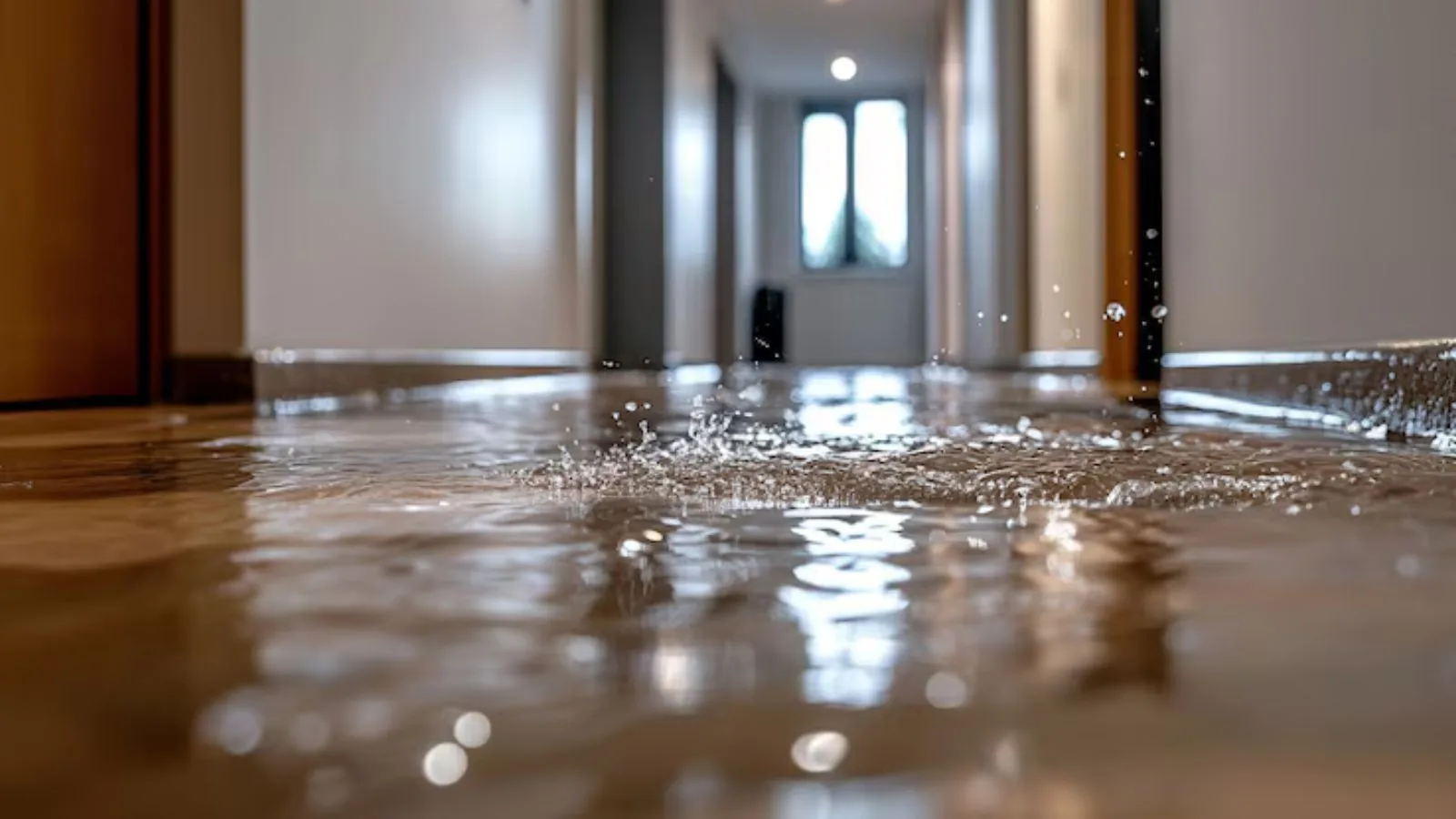
Not all water damage is the same, and the industry uses three categories to describe it. The categories come from the ANSI/IICRC S500 standard, and they decide how much cleaning, protective equipment and material removal a job needs.
Knowing the category helps you read an estimate and understand why a contractor may recommend removing carpet or drywall that looks salvageable.
The three categories
| Category | Source examples | Typical treatment |
|---|---|---|
| Category 1 | Broken supply line, sink overflow with clean water, rainwater from a roof | Extract and dry, many materials can stay. |
| Category 2 | Washing machine or dishwasher discharge, toilet overflow with urine only | Extract, clean, often remove carpet and pad. |
| Category 3 | Sewage, rising floodwater, long-standing stagnant water | Remove porous materials, clean and disinfect, then dry. |
Why the category can get worse
A clean-water leak does not stay clean forever. As water sits in carpet pad and wall cavities, it picks up dirt and microbes. After a day or two it can move up a category, and materials that could have been dried become materials that should be removed. That is a main reason speed matters.
What this means for your materials
- Carpet and pad: often dried in Category 1 with fast extraction and removed in Category 2 or 3.
- Drywall: dried in place for quick Category 1 losses, cut out in Category 3.
- Insulation: usually removed once it has been saturated.
- Hard surfaces such as tile and sealed concrete: cleaned and disinfected.
- Upholstery and mattresses: depends on category and time.
Safety checklist by category
Category 1: standard precautions and care around electrical items.
Category 2: gloves, boots and eye protection.
Category 3: full protective equipment, and keep children and pets out of the area.
A local note for Edgewater homeowners
The City of Edgewater operates the wastewater collection system and has been lining sewer pipes to reduce rain and groundwater getting into them. When heavy rain overwhelms a collection system, backups can reach low points, and that is a Category 3 event no matter how clear the water looks.
The city's flood-hazard information also describes localized flooding from low land and poor drainage and flooding near the Indian River Lagoon. Water that comes in from the ground, a yard or a street is treated as Category 3.
How to talk to a contractor about category
- Ask which category the contractor has assigned and why.
- Ask what changes if the water has been present for more than two days.
- Ask which materials will be dried and which removed.
- Ask for the category in writing on the scope.
- Share what you know about the source.
Classes are different from categories
Categories describe how contaminated the water is. Classes describe how much of the structure is wet. A small clean-water spill can be Class 1 and Category 1. A flood that soaked drywall and carpet across a house can be Class 2 or 3 and Category 3. The two labels together tell a crew how much equipment to bring and how much protective gear to wear.
When you read an estimate, look for both labels. If only one appears, ask for the other. A contractor who cannot say what class and category the job was assigned has not finished the assessment.
Common examples to help you picture each category
- A pipe under a bathroom vanity that splits and floods the floor: Category 1 at first.
- A dishwasher that overflows during a cycle: Category 2.
- A toilet that backs up from the main line: Category 3.
- Rain that runs down a wall from a failed roof flashing: Category 1 at first, then possibly worse as it sits in insulation.
- Water from a flooded yard that rolls under a door: Category 3.
The examples are patterns, not rules. Crews decide by looking at the source, the time and what the water touched, and by testing when needed.
How categories affect your safety at home
Category 1 water poses the least concern, but electrical items and slick floors are still risks. In Category 2 and 3, keep children and pets out and avoid wading barefoot. Wash with soap and clean water after contact, and tell your doctor if you notice symptoms after exposure. We do not give medical advice. For anything beyond a small spill of clean water, a trained crew is the safer choice.
If you are unsure which category applies, assume the higher one until a crew has looked. It costs little to be careful, and it is much harder to undo contact with contaminated water than to skip a precaution.
For sewage events, see sewage backup cleanup. For water that came in from outside, flood damage cleanup describes the steps. We also serve Scottsmoor and Mims.
Common questions
Grossly contaminated water, including sewage and rising floodwater. Porous materials that touch it are normally removed.
It can move up a category if it sits long enough, which is why quick action matters.
Rain that comes through a roof is often treated as Category 1 at first, but once it soaks insulation and sits, it can change.
In Category 2 or 3, carpet and pad hold contamination that cannot be reliably cleaned.
Yes. Higher categories involve more protective equipment, removal and cleaning.